Inflation and life-insurance-linked assets: a clearer view
Inflation does not act uniformly on life-insurance-linked assets. This article separates the three asset types by their inflation exposure and argues that the strategy has meaningful internal heterogeneity rather than a single inflation profile.
Inflation is the macro variable that most directly threatens nominal assets, and it is the one that allocators have had the most reason to think about in recent years. A natural question for anyone evaluating life-insurance-linked investing is how the asset class behaves when inflation runs higher than expected. The unhelpful answer is a single number or a single adjective. The more accurate answer is that the asset class is not one thing for this purpose: the three asset types we work in respond to inflation through different channels and with different magnitudes.
This article tries to give a clearer view by separating those channels. The aim is not to claim that the asset class is an inflation hedge — it is not, and claiming so would be misleading — but to describe its inflation exposure honestly, asset type by asset type, so that an allocator can see where the strategy is relatively insulated and where it is genuinely exposed.
The mechanism to keep in mind
Most of the inflation exposure in this asset class flows through one basic fact: the principal cash flows are nominal. A life insurance death benefit is a fixed dollar amount; an annuity's level payment is a fixed dollar amount; a loan's principal and interest are fixed dollar amounts. When inflation is higher than expected, the real value of a fixed nominal cash flow erodes. The size of that erosion depends almost entirely on one thing — how long you have to wait for the cash flow — because inflation compounds over time. A nominal dollar received soon has lost little real value; a nominal dollar received in many years has lost more.
This is why duration is the organizing variable for thinking about inflation here. The shorter the time to the cash flow, the less real-value erosion an inflation surprise can inflict. The longer the duration, and the more level and distant the nominal payments, the greater the exposure. With that mechanism in hand, the three asset types sort themselves naturally.
Definition: real-value erosion. The loss of purchasing power that a fixed nominal cash flow suffers when prices rise. A payment fixed in dollars buys less in real terms as inflation accumulates between today and the date it is received. The effect compounds with time, which is why duration is the central variable in assessing a nominal asset's inflation exposure.
Inflation exposure is not uniform
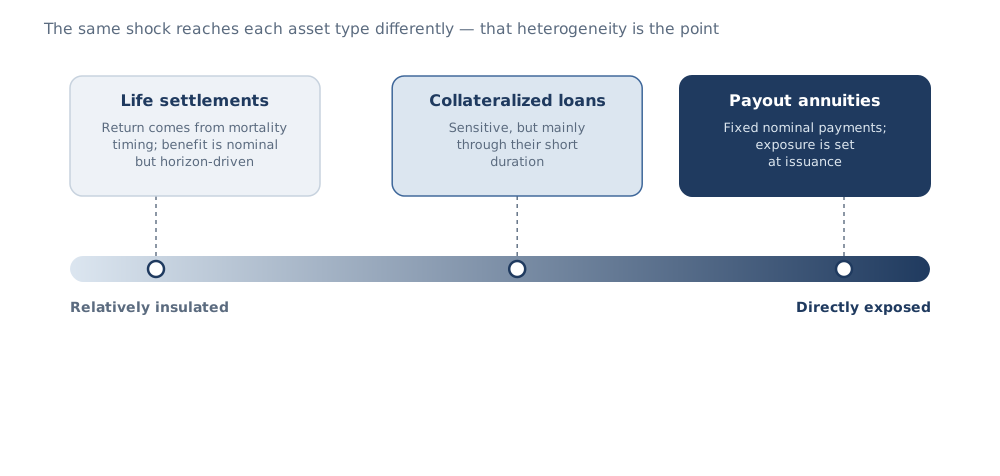
Life settlements: relatively insulated
Life settlements occupy the relatively insulated end of the spectrum, which is initially counterintuitive given that the death benefit is a fixed nominal amount. The resolution is duration. While the death benefit itself is nominal and distant, the realized durations in a diversified, sensibly underwritten portfolio are short enough that the compounding window for inflation is limited relative to a truly long-dated nominal bond. A portfolio of policies on older or impaired lives is, in effect, a stream of nominal cash flows arriving over a span of years rather than decades, which bounds the real erosion that an inflation surprise can produce.
There is a second, more subtle point. The premiums that must be paid to keep policies in force are also largely nominal and are driven by the policy's cost structure rather than by general price levels. Inflation does not mechanically inflate the premium obligations of an existing book the way it inflates, say, the operating costs of a business. The combination — nominal death benefits over moderate durations, with nominal premium obligations — makes the sleeve relatively insulated from inflation compared with a long-dated nominal instrument, though not immune. An extended period of high inflation would still erode the real value of distant death benefits.
Collateralized loans: inflation-sensitive, but through short duration
Policy-backed loans are inflation-sensitive in a way that is often favorable rather than damaging, and the reason is again duration — but operating in the opposite direction. Because these are typically shorter-duration instruments that mature, reprice, or roll over relatively quickly, the lender is not locked into the price level of a single moment. As loans mature and new lending is done, the terms can reflect the prevailing rate environment, which tends to move with inflation expectations. A short-duration lending book repositions to a higher-inflation environment over time rather than being trapped in the assumptions of a low-inflation past.
This does not make the loan sleeve an inflation hedge either. During the interval before repricing, the existing loans are nominal and exposed like any short-dated nominal instrument. But the short duration means the exposure is small in magnitude and self-correcting over time, as opposed to the locked-in exposure of a long-dated level payment stream. The loan sleeve is the one where inflation sensitivity is real but works through a repricing channel that limits its bite.
Payout annuities: directly exposed
Payout annuities are the genuinely inflation-exposed sleeve, and the analysis should say so plainly. A level-payment annuity is the textbook case of a long stream of fixed nominal payments. Each payment is fixed in dollars, the payments continue for many years, and the later payments are the ones most eroded by inflation. An unexpected, sustained rise in the price level reduces the real value of that income stream directly and substantially. This is the most straightforward inflation exposure in the asset class, and it is not small.
It is worth noting the partial offset that exists at the point of acquisition. Because annuity pricing reflects prevailing yields, and yields tend to rise with inflation expectations, new annuity exposure acquired in a higher-inflation environment is priced off higher yields. This affects the entry point rather than the inflation behavior of an existing position: an annuity already in payout has its level payments fixed, and those payments erode. The offset matters for when you buy, not for what happens to a contract you already hold.
Why the heterogeneity is the point
Pulling the three together produces a picture that is more interesting than a single inflation rating would suggest. Within one strategy, there is a relatively insulated sleeve (life settlements), a sleeve whose inflation sensitivity is real but short-duration and self-correcting (collateralized loans), and a directly exposed sleeve (payout annuities). The asset class has internal heterogeneity on inflation rather than a uniform exposure.
This heterogeneity is useful for two reasons. First, it means the strategy's overall inflation exposure is a function of the mix, which is a lever rather than a fixed property. Second, it cautions against the lazy summary that crops up in marketing materials — that the asset class is "inflation-protected" because mortality is real. Mortality being a real-world process does not make a nominal death benefit inflation-protected; the death benefit is still paid in dollars. The honest framing is that the asset class is relatively insulated in one sleeve, modestly and self-correctingly exposed in another, and directly exposed in the third.
Honest qualification. None of the three sleeves is an inflation hedge in the sense of payments that rise with the price level. Life settlements are relatively insulated by moderate duration; loans are exposed but reprice; annuities are directly exposed. An allocator looking for explicit inflation protection should look to instruments designed for it. What this asset class offers on inflation is a differentiated and partly manageable exposure, not a hedge.
How this should inform an allocation
For an allocator who is concerned about inflation specifically, the practical implications are straightforward. The life settlement sleeve can be held without the inflation worry that a long-dated nominal bond would carry, because its effective duration is shorter than its nominal description suggests. The lending sleeve carries an inflation exposure that is real but limited and self-correcting through repricing. The annuity sleeve carries a direct inflation exposure that should be sized and timed with that in mind, recognizing that its diversification and longevity-protection benefits come bundled with that nominal-payment risk.
The broader point is that inflation, like interest rates, acts on this asset class primarily through the nominal nature of its cash flows and the duration over which they arrive — not through any effect on the underlying mortality and longevity outcomes, which are unaffected by the price level. The biological engine of the asset class is inflation-indifferent. The dollar-denominated payments it produces are not. Keeping those two facts separate is what produces a clear view.
A short closing
Inflation is one of the few macro variables worth thinking carefully about in relation to this asset class, and the careful answer is a sorted one rather than a summary one. Life settlements are relatively insulated, collateralized loans are exposed but reprice, and payout annuities are directly exposed. The strategy's overall profile depends on the mix, and the honest framing avoids both the false comfort of calling the asset class inflation-protected and the false alarm of treating it as uniformly vulnerable.
For the closely related treatment of interest rate regimes, see The case for mortality-driven returns in any rate environment. For how the asset class behaves as a diversifier under stress more broadly, see Stress-testing 'uncorrelated': what we look for before calling an asset truly diversifying.
This article is for general information only and is not investment advice or an offer of any security. Questions about our research are welcome through Contact Us.
Interested in Learning More?
Sea Point Capital Partners, LP is an alternative asset manager focused on insurance-linked and longevity-linked strategies.
About the Author

Deep expertise in asset origination, pricing, and longevity risk management, as well as fund operations specific to life insurance assets.