The case for mortality-driven returns in any rate environment
The appeal of mortality-driven assets does not depend on a particular interest rate regime. This article examines how rate cuts, rate hikes, and stable rates each interact with the asset class, and threads the needle on rate sensitivity without pretending the assets are rate-insensitive.
Most arguments for an alternative asset class are, on inspection, arguments for a particular macroeconomic moment. A strategy is pitched as attractive because rates are low, or because rates are rising, or because some specific condition prevails that the pitch assumes will continue. The trouble with such arguments is that the moment passes, and the case for the asset passes with it. This article makes a different kind of argument: that the case for mortality-driven assets does not rest on any particular interest rate regime, because the thing that drives their cash flows is not interest rates at all.
That argument has to be made carefully, because it is easy to overstate. Mortality-driven assets are not rate-insensitive in every respect — payout annuities in particular are quite sensitive to rates at issuance, and the marked valuations of all three of the asset types we work in have some exposure to the discount rate. The honest version of the case distinguishes between the rate-independence of the underlying cash flows and the rate-sensitivity of the valuation channel. Both are real. This article is an attempt to hold both at once.
Two different things that "rate sensitivity" can mean
The single most useful distinction in this discussion is between the source of an asset's cash flows and the rate at which those cash flows are discounted to a present value. These are different channels, and conflating them is the source of most confusion about how the asset class behaves.
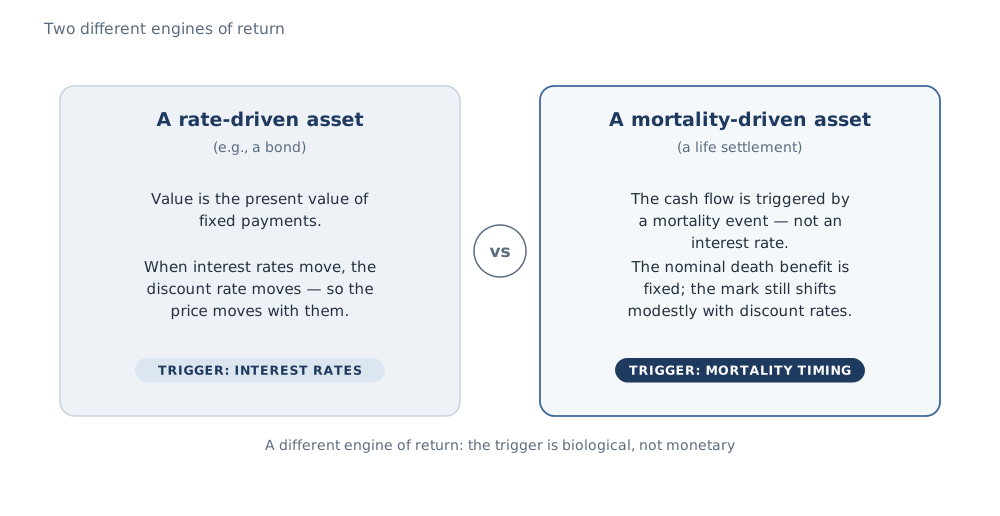
The cash flows of a life settlement are governed by when a specific insured passes away and by the premiums required to keep the policy in force in the meantime. Neither of these is a function of interest rates. A rate cut does not change a mortality outcome; a rate hike does not accelerate or delay it. The biological process that determines the timing of the ultimate cash flow runs on its own clock, indifferent to monetary policy. This is the sense in which the underlying return driver is genuinely distinct from the macro variables that move most of a portfolio.
The valuation of that same life settlement, however, does respond to rates. A portfolio of long-duration cash flows is worth more when discounted at a low rate and less when discounted at a high rate, all else equal. So a marked valuation of a life settlement book will move somewhat with the rate environment, even though the realized cash flows do not. The distinction is between what the asset will ultimately pay (rate-independent) and what it is marked at along the way (rate-sensitive). For an investor who holds to the natural duration of the assets, the first channel is what matters; the second is interim volatility around an outcome that develops on its own trajectory.
The core distinction: mortality-driven cash flows are not produced by interest rates, but the present value at which long-duration cash flows are marked does depend on the discount rate. An investor matched to the asset's duration experiences the first channel as the substance and the second as interim noise. An investor who may be forced to transact at interim marks experiences the second channel as real.
What pulls the cash flow
How the three asset types differ on rates
The asset class is not monolithic on this question. The three asset types we focus on sit at different points on the spectrum of rate sensitivity, and an honest argument has to acknowledge the differences rather than smoothing them over.
Life settlements: cash flows insulated, marks modestly exposed
Life settlements are the most rate-insulated of the three at the level of realized cash flows. The death benefit is a fixed nominal contractual obligation; the timing is mortality-driven; the premiums are a function of the policy's cost structure and the insured's age, not of market rates. The exposure that exists runs through the discount mechanism in valuation: marked values move modestly with the rate used to discount the expected cash flows. The realized return to a hold-to-maturity investor is largely a function of how actual mortality compares with the modeled distribution, not of what rates did in the interim.
Collateralized loans: rate-sensitive through short duration
Policy-backed loans sit at the more rate-sensitive end, but in a way that is often benign for the lender. Because these are typically shorter-duration instruments that can be repriced or rolled, their economics track prevailing rates more directly than a long-duration policy holding does. In a rising-rate environment, new lending can be done at higher yields; in a falling-rate environment, the opposite. The duration is short enough that the loan book repositions to the rate environment over time rather than being locked into the rates of a single moment.
Payout annuities: directly exposed at issuance
Payout annuities are the most directly rate-sensitive of the three, and pretending otherwise would be dishonest. The payout an annuity offers is set in large part by the rate environment at the time it is issued, because the insurer is pricing a long stream of payments against prevailing yields. This is not a flaw; it is simply the nature of the instrument. It does mean that the attractiveness of acquiring annuity exposure varies with the rate environment in a way that life settlements do not, and that the timing of entry matters more for this sleeve than for the others.
Walking through the three regimes
With those distinctions in place, the behavior of the asset class across rate regimes becomes legible. The point of this walk-through is not that the asset class is equally attractive in every regime, but that there is no regime in which the core case collapses.
Falling rates
When rates fall, the marked value of long-duration life settlement cash flows tends to rise through the discount channel, and existing annuity positions acquired at higher rates look more valuable in relative terms. New annuity issuance becomes less attractive, since payouts are priced off lower yields. The realized cash flows of the policy book are unaffected. The net picture is a regime in which the long-duration holdings are supported on a marked basis and the entry point for new annuity exposure is less favorable.
Rising rates
When rates rise, the marked value of long-duration cash flows comes under some downward pressure through the same discount channel — a headwind on interim marks, not on the realized cash flows for a hold-to-maturity investor. At the same time, new annuity issuance becomes more attractive, and new lending can be done at higher yields. A rising-rate environment is, in this sense, a mixed picture rather than a negative one: a modest drag on the marks of existing long-duration holdings, offset by better terms on new annuity and lending activity.
Stable rates
In a stable-rate environment, the discount channel is quiet, and the return to the asset class is dominated by its actual driver: how mortality outcomes compare with the modeled distributions on which acquisitions were priced. This is arguably the regime that most clearly reveals what the asset class is, because the noise of the valuation channel recedes and the underlying mortality-driven engine is what remains.
Across all three regimes, the realized cash flows of the policy holdings are governed by mortality timing rather than by rates. What changes across regimes is the interim marked valuation of long-duration holdings and the relative attractiveness of new annuity and lending activity. The case for the asset class does not require betting on a particular regime; it requires understanding which channel is operating in which regime.
Why this is the actual argument, not a rate forecast
It is worth being explicit about what this argument is not. It is not a forecast that rates will do anything in particular, and it is not a claim that the asset class delivers any specific return in any regime. We make no such claims, and a careful reader should be suspicious of anyone who does. The argument is structural: the dominant driver of the realized return — mortality timing — is independent of the rate cycle, and the rate sensitivity that does exist is concentrated in the valuation channel and in the entry point for the more rate-exposed sleeves.
This matters for portfolio construction in a specific way. An allocator who is uncertain about the path of rates — which is to say, every honest allocator — benefits from holding some exposure whose realized outcome does not hinge on getting the rate call right. Mortality-driven assets are unusual in offering that property at the level of cash flows, even as their marks carry some rate exposure. The value is not that the assets ignore rates entirely; it is that the thing they ultimately pay out is not a rate bet.
The honest qualifications
Three qualifications keep the argument honest. First, marked valuations do move with rates, so an investor who reports on a marked basis, or who might be forced to transact at interim marks, experiences rate sensitivity that a pure hold-to-maturity investor does not. Second, the annuity sleeve is genuinely rate-dependent at issuance, so the timing of entry into that sleeve matters in a way that this argument does not dissolve. Third, the structural insulation of the cash flows from rates is not the same as insulation from all risk: longevity risk, model risk, illiquidity, and carrier credit are all present and are addressed elsewhere in our research. Rate-independence of the cash flows is one property of the asset class, not a clean bill of health.
A short closing
The strongest version of the case for mortality-driven returns is also the most modest one. It does not claim the assets are immune to rates, and it does not depend on a view about where rates are going. It rests on a structural observation: the timing of mortality, which is what ultimately produces the return, is not a function of the rate cycle. The rate sensitivity that exists is real but is concentrated in the valuation channel and in the entry point for the rate-exposed sleeves, where it can be understood and managed rather than wished away.
For a closely related treatment focused on inflation rather than rates, see Inflation and life-insurance-linked assets: a clearer view. For the broader question of how the asset class stands up as a genuine diversifier, see Stress-testing 'uncorrelated': what we look for before calling an asset truly diversifying.
Sea Point Capital works with qualified investors and their advisors interested in insurance-linked investment strategies. To learn more about our approach, we welcome the opportunity to speak directly.
Interested in Learning More?
Sea Point Capital Partners, LP is an alternative asset manager focused on insurance-linked and longevity-linked strategies.
About the Author

Over 30 years capital markets experience in specialty finance, securitization, derivatives and insurance.