The life settlement market in 2026: where institutional capital has changed the game
Over the past decade the life settlement market has changed structurally: more institutional capital, more disciplined pricing, a deeper tertiary market, and far better service-provider infrastructure. This article surveys those changes and what they mean for an allocator looking at the category today.
It is easy to describe the life settlement market with a story borrowed from its past. The early market was exotic, lightly institutionalized, and dogged by the practices that gave it a poor reputation. That story is durable in part because it is dramatic and in part because the people telling it have rarely looked at the market recently. The market in 2026 is a different animal: larger, more institutional, more disciplined in its pricing, and supported by infrastructure that did not exist a decade ago. This article surveys what actually changed.
The aim is analysis rather than promotion. Some of the changes are unambiguously positive for an investor; others are double-edged, and a maturing market brings compression as well as confidence. The point is to give an allocator an accurate picture of the structural landscape as it is now, so that any decision about the category is made against the current reality rather than a decade-old caricature.
The shape of the market today
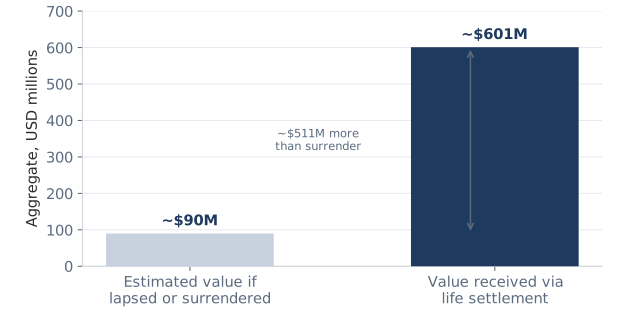
A few reference points help establish scale. The Life Insurance Settlement Association (LISA), whose licensed provider members are estimated to execute the large majority of secondary-market transactions, reported that its members completed 2,699 transactions in 2024 with an aggregate value of roughly 601 million dollars — proceeds that LISA estimates were on the order of 511 million dollars more than those same policies would have produced had they been lapsed or surrendered. LISA also reported that the average multiple delivered to selling policyholders in 2024 was more than six and a half times the cash surrender value, higher than in the two preceding years, which it attributed to strong institutional demand.
What selling policyholders received, 2024
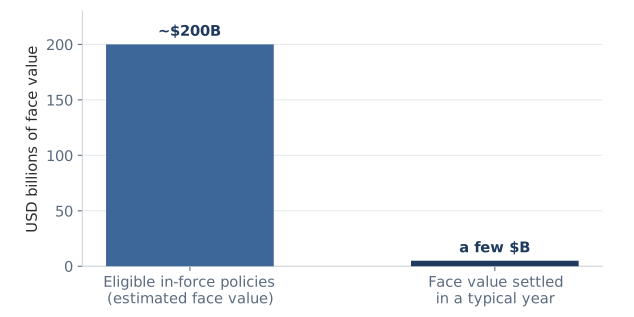
Against the size of the opportunity, transaction volume remains modest. The research firm Conning, which publishes an annual market report and forecast, has estimated the total face value of in-force policies that would meet investor criteria at around 200 billion dollars, against which only a few billion dollars of face value is settled in a typical year. The gap between eligible supply and actual transactions has been a persistent feature of the market, and it is the reason participants describe the category as underpenetrated rather than crowded.
Eligible supply vs. annual transaction volume
These figures are drawn from industry sources — LISA's annual market data and Conning's market research — and describe market activity and the benefit delivered to selling policyholders. They are not statements about investor returns, which depend on factors specific to each portfolio and manager. Industry data of this kind is useful for understanding scale and structure, not for inferring performance.
Change one: the character of the capital
The most consequential change is in who supplies the capital. In the formative years, the buyers were a narrower and less stable group. Over the past decade, institutional participants — pension funds, foundations, endowments, and the asset managers who serve them — have become materially more active in the space. This shift matters for reasons that go beyond the quantity of money.
Institutional capital tends to demand, and by virtue of its scale to receive, greater transparency and sounder operational practices from managers. It tends to be "stickier" through periods of stress, because long-horizon institutions are less prone to forced selling than the leveraged or short-horizon buyers who populated the early market. And it tends to bring less leverage, which reduces the systemic fragility that contributed to the forced-selling episodes of the past. A market funded by patient, demanding, lightly levered capital behaves differently from one funded by its opposite.
Change two: pricing discipline and underwriting
The second change is in how policies are priced. The early market's reputation for mispricing was not entirely unearned; life expectancy methodology was less mature, and the episodes in which industry-wide realized mortality diverged from modeled expectations left a lasting mark. The response, over the following years, was a tightening of the technical core of the market: more rigorous life expectancy underwriting, professional actuarial standards governing the mortality work, and a broader recognition that conservative assumptions are a discipline rather than a weakness.
More recently, the underwriting toolkit has expanded to include machine-learning techniques applied to medical records, used by serious participants as an augmentation of clinical and actuarial judgment rather than a replacement for it. The effect of all this is a market in which pricing is more disciplined and dispersion in underwriting quality, while still present, is narrower than it once was. Discipline cuts both ways for an investor: better-priced policies are safer, but better-priced policies also offer less room for the kind of easy mispricing that early entrants sometimes enjoyed.
Change three: the tertiary market and liquidity
The third change is the development of an active tertiary market — the trading of already-acquired policies and portfolios among institutions, as distinct from the secondary market in which policies are first sold by their owners. One of the few constructive legacies of the forced selling around the 2008 financial crisis was that it catalyzed a functioning market for whole portfolios. In the years since, tertiary trading volume has grown to the point that, by some industry accounts, it exceeds secondary volume.
A deep tertiary market matters because it provides two things the early market lacked: price discovery and a degree of liquidity. Price discovery means that marked valuations can be sanity-checked against actual transaction levels rather than resting on models alone. Liquidity — always partial and always worse in stress, as we are careful to say elsewhere — means that an institution that needs to adjust a position has somewhere to do it. Neither should be overstated; the asset class remains fundamentally illiquid. But the tertiary market is a genuine structural improvement over a market in which the only exit was to hold to maturity.
Change four: the service-provider infrastructure
The fourth change is the least visible and arguably the most important for institutional comfort: the maturation of the surrounding infrastructure. Running a life settlement portfolio at institutional scale depends on a chain of specialized service providers — fund administration, custody, premium servicing, policy tracking, independent valuation, audit, and tax preparation. In the early market, the firms capable of doing this work to an institutional standard were few. Today there is an established set of providers across each of these functions, which is what allows an allocator to expect the operational standards they would demand of any other alternative investment.
This infrastructure is what makes independent verification possible. Independent fund administration, independent valuation, and audit by a recognized firm are no longer aspirational features available only to the largest managers; they are the expected baseline. For an allocator, the maturation of this layer is what converts the asset class from one that requires taking a manager's word for everything into one where the key controls can be independently checked.
What has not changed
An honest survey has to note what the maturation has not altered. The fundamental risks of the asset class are structural and persist regardless of how institutional the market becomes. Longevity risk — the possibility that insureds live materially longer than modeled — remains the central risk. The assets remain illiquid, with holding periods measured in years. Model risk persists, because pricing still depends on actuarial estimates of an inherently uncertain quantity. Carrier credit exposure remains. And the wide dispersion in outcomes across managers, driven by differences in sourcing, underwriting, and operational discipline, has narrowed but not disappeared.
The maturation of the market also has not eliminated the persistent supply-demand gap. The fact that only a small fraction of eligible face value is settled each year reflects, among other things, low awareness among policyholders that selling is an option at all. This is a structural feature of the market with two faces: it limits how quickly capital can be deployed, and it means the opportunity is not, by the usual measures, a crowded one.
What it means for an allocator
The cumulative effect of these changes is that the question an allocator should be asking has shifted. A decade ago, the threshold question was whether the market was institutional enough to enter at all. Today the market clears that bar: the capital is more institutional, the pricing more disciplined, the liquidity deeper, and the infrastructure mature. The relevant question now is the one that always matters most in this category — manager selection — because the features that drive the wide dispersion in outcomes are not visible from a market-level survey. They live in how a specific manager sources policies, makes bid decisions, services premiums, values the book, and manages its service-provider relationships.
Our own view is that the maturation of the market is precisely what makes a disciplined, institutionally infrastructured approach worthwhile rather than redundant. A more disciplined market rewards the managers who do the operational work well and offers less to those relying on a market that no longer misprices as freely as it once did. We participate in this market as a mature one — with independent administration, independent valuation, audit by a registered firm, and underwriting that combines actuarial judgment with modern tools — because that is what the current market both permits and demands.
A short closing
The life settlement market in 2026 is not the market of its reputation. Institutional capital has changed its character; pricing has become more disciplined; a tertiary market has brought price discovery and partial liquidity; and a mature service-provider infrastructure has made institutional standards the baseline. None of this removes the fundamental risks, and a maturing market brings compression alongside confidence. But the threshold question of whether the market is investable has been answered by its own development, which moves the real work to the question that always mattered most: choosing the manager.
For how to evaluate a manager's underwriting and technology claims, see Where AI is actually changing underwriting — and where it's marketing. For the regulatory framework that underpins the market's investability, see Regulation as a feature: how state oversight made the life settlement market investable. For a fuller introduction to the category, see A family office introduction to life-insurance-linked assets.
Sea Point Capital works with qualified investors and their advisors interested in insurance-linked investment strategies. To learn more about our approach, we welcome the opportunity to speak directly.
Interested in Learning More?
Sea Point Capital Partners, LP is an alternative asset manager focused on insurance-linked and longevity-linked strategies.
About the Author

Over 30 years capital markets experience in specialty finance, securitization, derivatives and insurance.