Why most 'low correlation' claims don't survive a real downturn
Most assets marketed as uncorrelated reveal hidden equity, credit, or liquidity exposures precisely when it matters. This article argues that genuine uncorrelation is rarer than the marketing suggests, describes what it actually looks like, and explains why mortality-linked cash flows are an example.
There is a recurring disappointment in alternative investing. An asset is acquired for its low correlation to equities, it behaves as advertised for several years, and then a real downturn arrives and the correlation that was supposed to protect the portfolio turns out to have been conditional all along. The asset falls with everything else, often at the worst possible moment, and the diversification benefit that justified the allocation evaporates exactly when it was needed. This pattern is common enough that it deserves to be treated as the rule rather than the exception.
This article argues that most low-correlation claims do not survive a real downturn, explains the structural reasons why, and then asks what genuine uncorrelation would have to look like to be the exception. It is a sharper companion to our methodology piece on stress-testing uncorrelated claims; where that article lays out a framework for diligence, this one makes the blunter argument about why the framework is necessary in the first place.
The number that does the lying
The root of the problem is that the headline correlation statistic — usually a single coefficient against a broad equity index, computed over some convenient sample — is doing far more work than it can bear. A correlation coefficient is an average of a linear relationship over a period. It tells you how two series moved together on a typical day in the sample. It tells you very little about how they will move together on the atypical days that determine whether a portfolio survives.
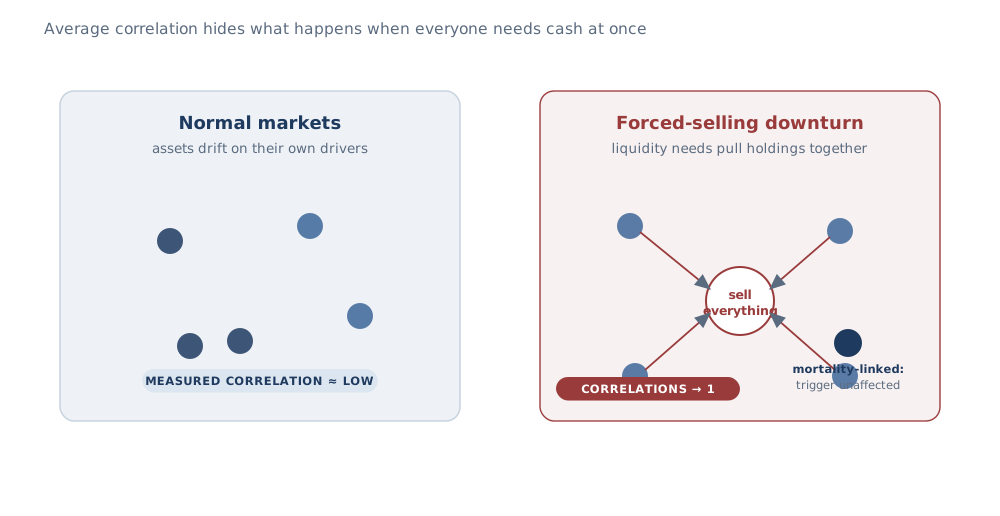
The atypical days are the entire point of diversification. An allocator does not hold an uncorrelated asset for its behavior in a calm market; they hold it for its behavior in a crisis. So the relevant question is not what the average correlation has been, but what the correlation becomes when equities fall 30 percent, when credit spreads gap wider, when volatility spikes, and when everyone needs cash at once. A low average correlation that conceals a high crisis correlation is not diversification. It is a diversification story that has not yet been tested.
The core failure: a low unconditional correlation can coexist with high correlation during stress. The headline number averages over calm and crisis alike, and calm periods dominate the sample. The diversification an allocator is paying for lives entirely in the crisis periods, which the average obscures rather than reveals.
Correlation in calm vs. a forced-selling downturn
The three ways the claim usually fails
When a supposedly uncorrelated asset disappoints in a downturn, the failure almost always runs through one of three channels. Naming them is useful, because each can be probed in advance.
Hidden equity beta
Many alternative strategies marketed as uncorrelated turn out, on factor decomposition, to carry substantial equity market exposure dressed in different clothing. The factor-investing literature has documented this repeatedly: a great deal of what is sold as alpha or as uncorrelated return is equity beta with a lag, a smoothing, or a label. A long-standing finding in that literature is that the average returns of broad hedge fund categories have exhibited high correlation to long-only equities once the exposures are examined properly — a result that sits awkwardly with the marketing of the category as a diversifier. When the hidden beta is present, the asset falls with equities in a downturn because it was, in substance, an equity exposure all along.
Hidden credit exposure
A second common channel is credit. Strategies that earn a steady premium in normal times frequently do so by bearing credit or liquidity risk that is invisible until spreads widen. The return looks uncorrelated with equities during expansions, because credit and equities can diverge in calm periods. But in a genuine downturn, credit spreads and equity prices move together, and the strategy's credit exposure surfaces as a correlation with the equity drawdown that the historical statistic never showed. The premium was compensation for a risk that only shows up in the tail.
Liquidity-driven co-movement
The third channel is the most insidious because it can affect even assets whose fundamentals genuinely are unrelated to markets. In a broad selloff, investors who need cash sell what they can sell. If a normally illiquid asset has any secondary market at all, forced sellers will hit it, and its price will fall alongside the assets that triggered the selling — not because its fundamentals changed, but because its holders needed liquidity. This liquidity-driven co-movement has appeared across crises in 1998, 2008, and 2020. An asset can have fundamentals that are completely uncorrelated with equities and still trade down in a crisis through this channel, if its holders are forced to sell.
What genuine uncorrelation would have to look like
If those are the three ways the claim fails, then a genuinely uncorrelated asset is one that closes off all three. Its returns must not load on equity beta when the factors are decomposed. It must not be earning a quiet credit premium that surfaces when spreads widen. And — the hardest test — its fundamental cash flows must be driven by something that has no mechanism connecting it to market stress, so that even if its price wobbles through the liquidity channel, the cash it ultimately produces is unaffected.
That last requirement is the demanding one, because it rules out most candidates. Almost everything in a portfolio is connected to the economy somehow: corporate earnings, real estate rents, commodity demand, credit performance, consumer behavior — all of these are, in the end, tied to the same macroeconomic conditions that drive equities, even when the connection is loose in calm periods. Genuine structural independence requires a return driver that is not economic at all.
Why mortality-linked cash flows are an example
This is the test against which mortality-linked cash flows stand out, and it is worth being precise about why, because the argument is structural rather than a claim about any historical return series. The cash flows of a life settlement are governed by the timing of individual mortality outcomes. Mortality is a biological process. A recession does not change when a given insured will pass away; an equity drawdown does not accelerate or delay it; a credit crisis has no mechanism by which it reaches into the mortality distribution of a diversified pool of insured lives. The return driver is not an economic variable, which is exactly the property the test requires.
Run the asset class through the three failure channels and it closes off the first two cleanly. There is no hidden equity beta in a death benefit; the obligation does not move with the stock market. There is no hidden credit premium of the conventional kind, though there is a genuine and acknowledged carrier-credit exposure that is distinct from broad market credit. The factor exposures that remain — a mortality and longevity factor, and a carrier-credit factor — are precisely the exposures that a typical institutional portfolio does not already own, which is the structural source of the diversification.
The honesty of the argument depends on what it says about the third channel. Mortality-linked assets do not close off the liquidity channel. They are illiquid in all environments and more so under stress, and a holder forced to sell into a stressed secondary market would experience a co-movement with the broad selloff that does not exist in the underlying cash flows. This is the one place the asset class shares the vulnerability of other alternatives, and pretending otherwise would undercut the entire argument. The distinction that matters is between the cash flows, which are structurally independent of market stress, and the interim marks for a forced seller, which are not.
Honest qualification. No asset is perfectly uncorrelated. Mortality-linked cash flows are structurally independent of equity, credit, and rate stress, which closes off the hidden-beta and hidden-credit channels. They remain subject to the liquidity channel for any holder forced to sell into a stressed market. The case is that the underlying cash flow risk is unrelated to market variables, not that no co-movement exists in any circumstance.
The discipline this argues for
The practical conclusion is not that allocators should distrust all uncorrelated claims, but that they should test them against the three channels before believing them. Decompose the factor exposures and look for hidden equity beta. Ask what premium the strategy earns in calm times and whether it is quietly bearing credit or liquidity risk to earn it. And separate the fundamental cash flow behavior from the marked behavior under forced selling, because those can have very different answers. An asset that passes the first two tests and is held in a structure matched to its illiquidity — so that the holder is not a forced seller — is a genuine diversifier. Most candidates fail at least one of these. The rare ones that pass are worth finding.
We apply this test to our own asset class as rigorously as to any other, because no fair argument exempts it from the same scrutiny. The conclusion we reach is that the structural independence is real and the liquidity vulnerability is real, and that an investor matched to the duration of the assets captures the first without being exposed to the second. That is a more modest and more defensible claim than "uncorrelated," and it is the one we are willing to make.
A short closing
Most low-correlation claims do not survive a real downturn because most of them rest on a single average that conceals hidden equity beta, hidden credit exposure, or a liquidity vulnerability that only appears under stress. The discipline is to probe those three channels in advance rather than discovering them in the drawdown. Genuine uncorrelation requires a return driver that is not an economic variable at all, which is a high bar that most candidates fail and that mortality-linked cash flows clear at the level of fundamentals — while remaining honest about the liquidity channel they do not escape.
For the full diligence framework behind this argument, see Stress-testing 'uncorrelated': what we look for before calling an asset truly diversifying. For a practical version aimed at advisors, see Three questions every RIA should ask a manager claiming uncorrelated returns.
Sea Point Capital works with qualified investors and their advisors interested in insurance-linked investment strategies. To learn more about our approach, we welcome the opportunity to speak directly.
Interested in Learning More?
Sea Point Capital Partners, LP is an alternative asset manager focused on insurance-linked and longevity-linked strategies.
About the Author

Deep expertise in asset origination, pricing, and longevity risk management, as well as fund operations specific to life insurance assets.