Three questions every RIA should ask a manager claiming uncorrelated returns
A short, practical due-diligence framework an advisor can apply to any "uncorrelated" pitch — three questions that separate genuine diversifiers from repackaged market exposure, with a note on where insurance-linked assets land.
An advisor evaluating alternatives hears the word "uncorrelated" constantly, and rarely has time to run a full quantitative diligence process on every pitch that uses it. What an advisor needs is not another forty-page framework but a small number of questions that can be asked in a first meeting and that reliably separate a genuine diversifier from market exposure wearing a costume. This article offers three such questions, written to be used rather than admired.
The three questions are deliberately blunt. Each targets one of the ways a low-correlation claim usually falls apart. A manager with a real diversifier will be able to answer all three in plain language; a manager relying on a flattering statistic will tend to deflect on at least one. The questions are not a substitute for deeper diligence on a strategy you decide to pursue, but they are an efficient filter for deciding which claims deserve that deeper look.
Three questions for any “uncorrelated” manager
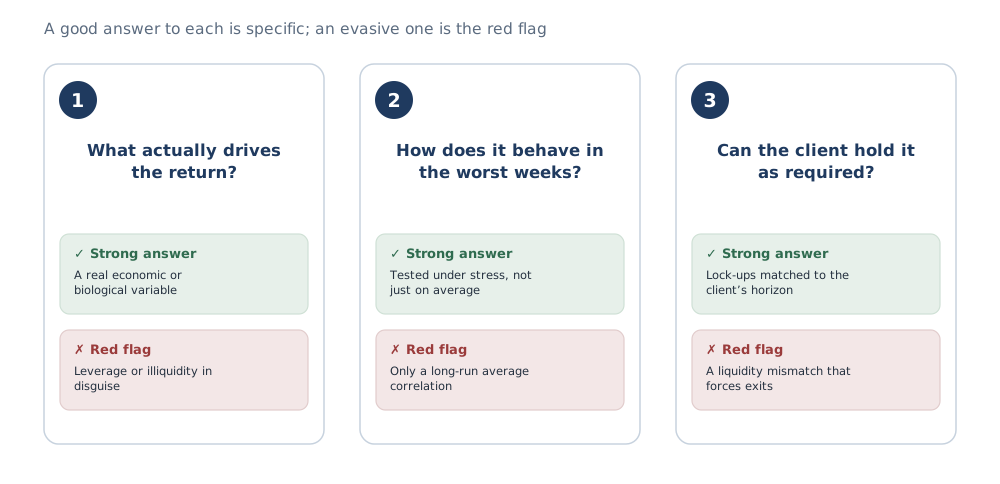
Question one: what actually drives the return, and is it an economic variable?
The first question goes straight to the source of the return. Ask the manager to name the underlying driver of the strategy's cash flows, and then ask whether that driver is, at bottom, an economic or market variable. The reason this matters is simple: if the return is ultimately produced by corporate earnings, real estate income, credit performance, commodity demand, or consumer behavior, then it is tied — however loosely in calm periods — to the same macroeconomic conditions that drive equities. A genuinely diversifying return requires a driver that is not economic at all.
Listen for whether the answer describes a distinct risk being transferred and compensated, or whether it describes a familiar market exposure with a new label. A useful follow-up: when the strategy is decomposed into its factor exposures, what does it load on? If the honest answer is equity beta or credit risk in alternative clothing, the diversification claim is already in trouble, regardless of what the historical correlation coefficient says. A manager who can clearly articulate a non-economic return driver, and who can name the specific factors the strategy does and does not load on, has passed the first and most important test.
Why this is question one. The single most common failure of an uncorrelated claim is hidden factor exposure — equity beta or credit risk that does not show up in calm periods but surfaces in a downturn. A return driver that is genuinely non-economic is the only thing that closes off this failure at the source. Everything else is downstream of this answer.
Question two: how does it behave in the worst periods, not on average?
The second question reframes the entire conversation away from the average. A correlation coefficient summarizes typical behavior over a sample dominated by calm periods. But a client does not hold a diversifier for its behavior on a typical day; they hold it for its behavior when equities fall sharply, when credit spreads widen, and when volatility spikes. So ask the manager directly: what does the strategy do in those specific conditions? Not on average — in the worst quintile of equity returns, in a credit selloff, in a volatility shock.
A serious manager will have a view on this, ideally grounded in how the strategy actually behaved in past stress episodes or, where the track record is short, in a structural explanation of why the behavior should hold. Be wary of an answer that simply restates the long-run correlation number, because that is precisely the statistic that conceals stress behavior. The question you are really asking is whether the low correlation is conditional — present in calm periods and absent when it matters — or whether it holds across regimes. A manager who has thought about regime-conditional and tail behavior will engage with the question; one who has not will retreat to the average.
Question three: can my client hold it the way it needs to be held?
The third question is about structure and suitability, and it is the one advisors most often skip. Even a strategy with a genuinely non-economic return driver can disappoint a client if the holding structure is mismatched to the client's needs. Many diversifying assets are illiquid, and illiquidity creates a specific trap: in a broad selloff, an investor who needs cash sells what they can, and forced selling can drag down even an asset whose fundamentals are unrelated to markets. The asset's cash flows might be perfectly uncorrelated while its forced-sale price is not.
So ask what the strategy requires of the holder. What is the liquidity profile? What are the lock-ups, gates, and notice periods? And — the question that ties it to your specific client — can this particular client hold the asset through a multi-year period without being forced to sell at a bad moment? If the answer is yes, the client captures the diversification. If the answer is no, the client may experience the asset's worst behavior precisely when they can least afford it. Liquidity behavior under stress is not something the manager manages on the client's behalf; it is something the advisor manages by matching position size to the client's genuine tolerance for illiquidity.
The three questions, together. What drives the return, and is it non-economic? How does it behave in the worst periods rather than on average? And can this client hold it the way it must be held? A strategy that answers all three well is a candidate for deeper diligence. A strategy that deflects on any of them probably is not the diversifier it claims to be.
Running the questions on insurance-linked assets
It would be unfair to offer this framework without running our own asset class through it honestly, so here is how life-insurance-linked assets answer the three questions. On the first, the answer is unusually clean: the return driver is the timing of mortality and longevity outcomes, which is a biological process, not an economic variable. A recession does not change when an insured passes away, and a credit crisis has no path into the mortality distribution of a diversified pool. The strategy's distinctive factor exposures — mortality and carrier credit — are not the exposures a typical portfolio already owns.
On the second question, the same structural logic supports the stress behavior: the mortality outcomes that produce the cash flows are not concentrated in market crises, so the fundamental cash flows do not co-move with equity drawdowns. On the third question, the asset class requires honest acknowledgment of a real constraint: it is illiquid in all environments and more so under stress, with holding periods measured in years. The cash flows are structurally independent of markets; the forced-sale price is not. This is exactly why the third question is decisive for the asset class — it is suitable for a client with patient, long-horizon capital, and unsuitable for one who may need liquidity. The framework does not exempt the asset class from its own test; it shows precisely where the asset class is strong and where the suitability constraint binds.
A short closing
The value of three questions is that they fit in a meeting and in memory. Ask what drives the return and whether it is non-economic; ask how the strategy behaves in the worst periods rather than on average; and ask whether your client can hold it the way it must be held. The questions work on any uncorrelated claim, including ours, and the honest answers tend to reveal more than any correlation statistic a marketing deck will offer. An advisor armed with these three questions is in a position to tell a genuine diversifier from a repackaged market exposure, which is most of the battle.
For the fuller quantitative framework behind these questions, see Stress-testing 'uncorrelated': what we look for before calling an asset truly diversifying. For the argument about why most low-correlation claims fail under stress, see Why most 'low correlation' claims don't survive a real downturn.
Sea Point Capital works with qualified investors and their advisors interested in insurance-linked investment strategies. To learn more about our approach, we welcome the opportunity to speak directly.
Interested in Learning More?
Sea Point Capital Partners, LP is an alternative asset manager focused on insurance-linked and longevity-linked strategies.
About the Author

Over 30 years capital markets experience in specialty finance, securitization, derivatives and insurance.