State guaranty associations and what they actually protect
The state guaranty association system is the final backstop behind an insurance carrier that becomes insolvent. This article explains how the system is funded, what it covers and to what limits, its historical track record, and how an investor with annuity-backed exposure should think about it.
Every dollar of death benefit in a life settlement, and every dollar of income from a payout annuity, is ultimately a contractual obligation of an insurance carrier. That makes carrier solvency one of the structural risks of insurance-linked investing. Behind the carrier sits a layer of protection that is frequently mentioned and rarely understood: the state guaranty association system. This article describes what that system actually is, how it is funded, what it covers and to what limits, and how a sophisticated investor should weigh it.
The intent is to be accurate rather than reassuring. The guaranty system is a meaningful backstop, but it is not a guarantee in the colloquial sense, and treating it as one would be a mistake. A clear picture of what it does — and what it does not do — is more useful than either the dismissive or the complacent view.
What a guaranty association is
A state guaranty association is a body, created by state law, that pays the covered claims of an insolvent insurance carrier up to limits the state sets. Every U.S. state, the District of Columbia, and Puerto Rico maintains a life and health insurance guaranty association, and every carrier licensed to sell life insurance, health insurance, or annuities in a state is required to be a member as a condition of doing business there. Coverage generally follows the policyholder's state of residence.
The associations are coordinated, for failures that span multiple states, through the National Organization of Life and Health Insurance Guaranty Associations (NOLHGA), formed in 1983. When a carrier licensed in many states is declared insolvent, NOLHGA assembles a task force of the affected associations, which analyzes the carrier's obligations, keeps coverage in place while claims are paid, and where possible arranges for covered policies to be assumed by a financially healthy carrier. The underlying statutes in most states are built on the NAIC Life and Health Insurance Guaranty Association Model Act.
Definition: guaranty association. A state-mandated body that pays the covered claims of an insolvent insurance carrier up to statutory limits. It is sometimes compared to the FDIC for banks, but the comparison is loose: guaranty associations are organized state by state, funded differently, and capped at lower limits than federal deposit insurance.
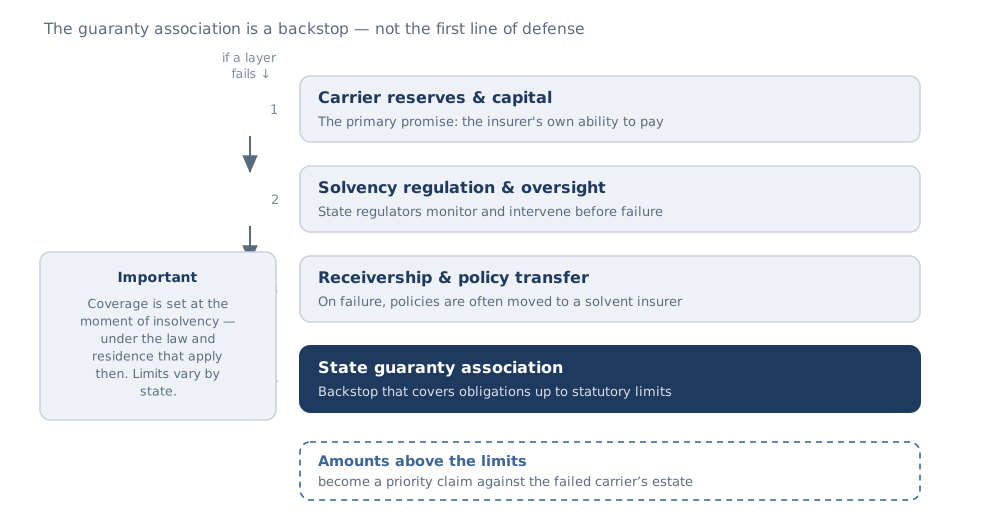
What stands behind a policy
How the system is funded
This is the feature most often misunderstood. Guaranty associations are not pre-funded reserve pools sitting in an account waiting for a failure. They are funded after the fact, through assessments levied on the surviving member carriers in proportion to their premium volume in the relevant lines of business in that state. When a carrier fails, the other carriers operating in the same state are assessed to cover the shortfall, subject to annual caps on how much any one carrier can be assessed.
Two implications follow from the post-assessment structure. First, the system's capacity is, in effect, the assessment capacity of the surviving industry, which is large but not unlimited and is drawn down over time rather than paid instantly. Second, because assessments are partly recoverable by carriers through premium tax offsets in many states, the ultimate cost is shared in a way that spreads across the system. For an investor, the practical takeaway is that recovery through the guaranty system can be partial and can take time, even when the statutory coverage applies.
What is covered, and to what limits
Coverage limits are set by each state and vary, but most states cluster around a common set of minimums drawn from the model act. As a general matter, most states cover at least 300,000 dollars in life insurance death benefits, at least 100,000 dollars in net cash surrender value, and at least 250,000 dollars in the present value of annuity benefits. Many states also impose an aggregate cap — frequently around 300,000 dollars — on the total benefits payable to any one individual across all policies with a single insolvent carrier. Some states are more generous; New Jersey, for example, covers life insurance death benefits and annuity present value at higher levels.
Several details matter for anyone evaluating annuity-backed exposure specifically. The annuity limit typically applies to the present value of the benefit, not the contract's face amount or total expected payout. Limits apply per individual, per insurer, so spreading exposure across multiple carriers can raise the total amount protected. Unallocated group annuity contracts, where covered, carry their own and generally higher cap. And coverage is determined at the moment of insolvency under the law in effect at that time, not the law when the contract was issued.
These figures are illustrative of the common statutory minimums and are not guarantees of coverage in any particular case. Limits, definitions, and aggregate caps vary by state and change over time. The authoritative source for any specific situation is the relevant state's guaranty association statute and the guaranty association laws database maintained by the system itself.
What the system does not do
The guaranty association is a backstop of last resort, and its design reflects that. It does not cover the non-guaranteed portions of variable products, where the policyholder bears the investment risk. It does not cover amounts above the statutory limits, although those excess amounts generally become a priority claim against the estate of the failed insurer, through which a policyholder may recover further as the insurer's assets are liquidated. And, importantly, many states restrict carriers and agents from advertising the existence of the guaranty fund as a sales inducement, on the view that solvency, not the backstop, is what a buyer should be evaluating.
For an institutional holder of policies or annuities, the guaranty system should therefore be understood as a floor under a worst case, not as a substitute for carrier diligence. A portfolio concentrated in a single weak carrier is not made safe by the existence of a guaranty association; it is merely given a partial, capped, and potentially delayed recovery if the carrier fails. The first line of defense is carrier selection and diversification. The guaranty system is the last.
The historical track record
Life insurance carrier insolvencies have been historically rare relative to many other corners of finance. State-level solvency regulation, risk-based capital requirements, the long-duration and relatively predictable nature of life insurance liabilities, and rating-agency scrutiny have together produced a sector with a low failure rate through multiple economic cycles. When failures have occurred, the guaranty system has generally functioned as designed: covered policyholders within the limits have been protected, often through the transfer of policies to a healthy carrier rather than through a cash payout, and the disruption has been contained.
None of this is a guarantee about the future. A low historical failure rate is context for sizing exposure, not a promise that no large carrier will ever fail or that the assessment capacity of the system would be untested by a very large, multi-state insolvency. The appropriate posture is to treat carrier credit as a real, long-duration exposure that the guaranty system contains rather than eliminates.
How an investor should think about this layer
For an investor in annuity-backed or policy-backed strategies, the guaranty system should inform the analysis in a few concrete ways. Carrier credit quality, monitored through the major rating agencies, is the primary control. Diversification across many highly rated carriers reduces the chance that any single failure is material, and because limits apply per insurer, diversification also expands the aggregate statutory protection. Position sizing should reflect the reality that recovery through the guaranty system can be partial and delayed. And the per-individual structure of the limits means that the protection is most meaningful for retail-scale exposures; large institutional positions sit well above the statutory caps and rely far more on carrier solvency than on the backstop.
We treat carrier credit as one of the genuine risk factors in the asset class, addressed primarily through diligence and diversification, with the guaranty system understood as the final and partial layer rather than the main protection. That framing keeps the analysis honest: the system is real and valuable, and it is also limited, capped, and slow. Both halves of that sentence matter.
A short closing
The state guaranty association system is one of the reasons insurance-linked cash flows rest on relatively solid ground: there is a statutory safety net behind the carrier, organized in every state and coordinated nationally for multi-state failures. It is also a backstop with real limits — capped, funded after the fact, and partial above those caps. An investor who understands both the protection and its boundaries is in a position to size carrier exposure sensibly, which is the entire point of understanding the layer in the first place.
For a fuller treatment of how carrier credit fits into the broader risk picture of the asset class, see our overview at A family office introduction to life-insurance-linked assets and our examination of the risks in the honest case against the category at The honest case against life-insurance-linked assets.
Sea Point Capital works with qualified investors and their advisors interested in insurance-linked investment strategies. To learn more about our approach, we welcome the opportunity to speak directly.
Interested in Learning More?
Sea Point Capital Partners, LP is an alternative asset manager focused on insurance-linked and longevity-linked strategies.
About the Author

Deep expertise in asset origination, pricing, and longevity risk management, as well as fund operations specific to life insurance assets.