The vocabulary of insurance-linked investing
A working glossary of the terms an RIA or family office reader will encounter when evaluating life-insurance-linked assets. Each entry is written to be read on its own, and the page is meant to be kept as a reference rather than read end to end.
Insurance-linked investing carries a vocabulary that is unusually dense for the size of the asset class. Some of the terms are borrowed from actuarial science, some from insurance law, and some from the trading desks that built the secondary market. A reader encountering the category for the first time can find that the language itself is a barrier before any of the underlying ideas have had a chance to be evaluated on their merits.
This page is a reference rather than an argument. It is meant to be kept open in a second tab while reading our other articles, or skimmed once and returned to. The definitions are deliberately plain. Where a term is frequently confused with another, we say so. Where a term carries historical baggage, we note it. Nothing here is a recommendation, and none of the definitions should be read as a claim about returns.
How the vocabulary fits together
Core concepts
Insurance-linked asset
An asset whose cash flows depend principally on insurance contract outcomes — mortality, longevity, claims, or recoveries — rather than on the market price of equities, bonds, or commodities. The category spans life settlements, payout annuities, policy-backed loans, catastrophe bonds, and reinsurance vehicles. Life-insurance-linked assets are the subset whose underlying risk is mortality and longevity rather than property or casualty events.
Insurable interest
The legal requirement that the original purchaser of a life insurance policy have a genuine stake in the continued life of the insured — typically a family or financial relationship — at the time the policy is issued. Insurable interest must exist at inception; it is not required to persist for the policy to remain valid, which is the legal foundation that allows a policy to be sold later in life. The distinction between a policy that had insurable interest at issue and one manufactured purely for resale is the line that separates a legitimate life settlement from stranger-originated life insurance.
Death benefit
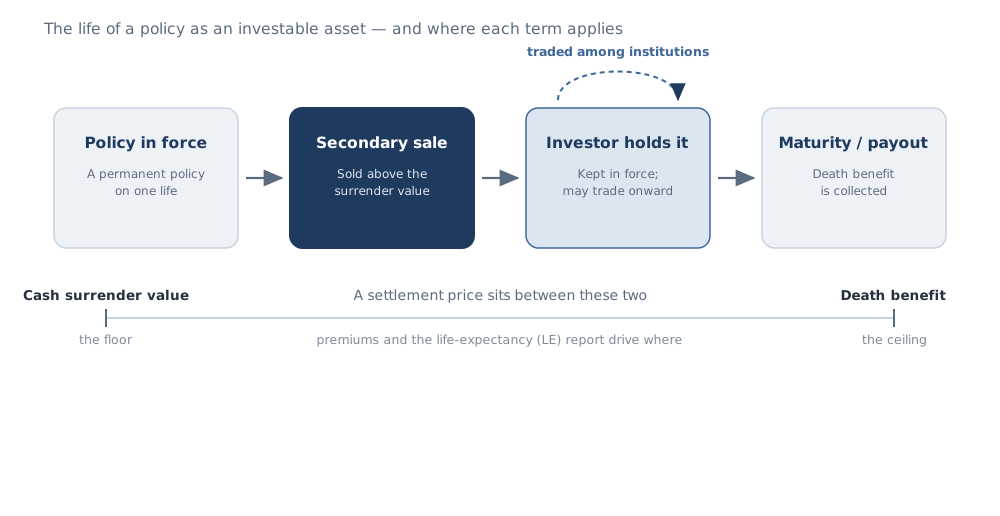
The face amount an insurance carrier pays when the insured passes away, net of any policy loans or unpaid charges. In a life settlement, the death benefit is the ultimate cash flow the investor is acquiring exposure to. It is a contractual obligation of the carrier and is nominal — fixed in dollar terms rather than indexed to inflation.
Life settlement terms
Life settlement
The sale of an in-force life insurance policy by its owner to a third party for more than the cash surrender value but less than the death benefit. The buyer takes over premium payments and receives the death benefit when the insured passes away. The transaction is regulated at the state level in most of the country and gives a policyholder who no longer wants the coverage a third option beyond surrendering the policy or letting it lapse.
Cash surrender value
The amount a carrier will pay a policyholder to cancel a permanent life insurance policy before the insured's death. For many older policies it is substantially lower than the policy's economic value in the secondary market, which is the reason a sale can be materially better for the policyholder than a surrender. Cash surrender value is the floor against which any life settlement offer is measured.
Cost of insurance (COI)
The mortality charge a carrier deducts from a universal life policy to cover the pure insurance risk, separate from any savings or expense components. Cost of insurance rises with the insured's age and is the central variable in projecting how much premium a policy will require to stay in force. Understanding the COI structure of a specific policy is essential to projecting its future premium obligations, which is one of the larger drivers of a life settlement's economics.
Premium (and minimum premium to maintain)
The ongoing payment required to keep a policy in force. A buyer's return depends heavily on the premium stream paid between acquisition and the death benefit, so a discipline of paying the minimum premium necessary to maintain coverage — rather than a default scheduled premium — is a meaningful operational task. See our article on premium servicing for a fuller treatment.
Life expectancy (LE) report
A document produced by a specialist medical underwriting firm that summarizes the mortality distribution for a specific insured based on medical records and applicable actuarial tables. The LE is usually expressed as a median number of months, with an underlying mortality curve available to the buyer's pricing model. An LE report is an estimate of a probability distribution, not a prediction of a date; readers who treat it as the latter tend to misunderstand the risk.
Mortality multiplier
A factor applied to a standard mortality table to reflect that a specific insured is expected to die faster (a multiplier above 100 percent) or slower (below 100 percent) than a baseline life of the same age and sex. An impaired life with serious medical conditions carries a high multiplier; a healthy life carries a low one. The multiplier is the actuarial shorthand for how an underwriter has translated a medical file into a mortality view.
Impairment
A medical condition that raises an insured's mortality relative to a standard life. Underwriting assigns debits for impairments and, less often, credits for favorable factors. The accumulation of debits and credits produces the mortality multiplier. Rare impairments are harder to underwrite reliably than common ones, because the data supporting any mortality estimate is thinner.
Viatical settlement
The sale of a policy by an insured who is terminally or chronically ill, as distinct from a life settlement, in which the insured is typically older but not necessarily ill. Viaticals predate the modern life settlement market and were its historical origin in the context of a public health crisis in the late 1980s and early 1990s. Today the institutional market is overwhelmingly composed of life settlements; viaticals are treated separately and are a small share of activity. We mention the term mainly so that readers can distinguish it from the asset class as it exists now.
A note on terminology. "Life settlement," "viatical settlement," and the popular-press label "death bonds" are not interchangeable. The first is the contemporary institutional asset; the second is a narrow, historically distinct, illness-driven transaction; the third is a colorful but inaccurate phrase, since a life settlement is not a bond and its cash flows are mortality-linked rather than interest-linked.
Annuity and longevity terms
SPIA (single premium immediate annuity)
An annuity purchased with one upfront payment in exchange for a stream of income that begins almost immediately and continues for the annuitant's life or a fixed term. A SPIA converts a lump sum into longevity-protected income; from an investor's standpoint, payout annuities of this kind generate cash flows whose duration depends on how long the annuitant lives.
Mortality credit
The additional return an annuitant effectively receives from the pooling of longevity risk — the benefit that accrues to those who live longer, funded by the pool of annuitants as a whole. Mortality credit is the structural reason a lifetime annuity can pay more than a self-managed drawdown of the same capital would safely support. It is the longevity analogue of the mortality exposure in a life settlement, running in the opposite direction.
Longevity swap
A contract that transfers longevity risk from one party to another, typically used by pension schemes and insurers to hedge the risk that a population lives longer than expected. Longevity swaps are part of the broader institutional machinery for managing the same biological risk that sits at the center of life-insurance-linked investing, approached from the liability side.
Lending and structure terms
Policy-backed (collateralized) loan
A loan secured by a portfolio of life insurance policies or settlement interests as collateral. The lender's return comes from the interest and structure of the loan rather than directly from mortality timing, while the policies serve as the security behind the obligation. This is a distinct asset type from holding policies outright, with a different — and generally shorter-duration — return profile.
ILS (insurance-linked securities)
A broad term for tradable instruments whose performance is tied to insurance risk. In common usage ILS most often refers to property-and-casualty instruments such as catastrophe bonds, but the term properly encompasses life and longevity instruments as well. When a manager uses "ILS" it is worth clarifying whether they mean catastrophe risk, mortality and longevity risk, or both, because the underlying drivers are entirely different.
Net asset value (NAV) and marked valuation
The stated value of a fund or portfolio, which for illiquid insurance-linked assets is produced by a model rather than by observed market prices. Marked valuations rest on discount-rate, mortality, and premium-projection assumptions, and reasonable people can produce different values from the same portfolio. This is why independent third-party valuation and audit matter in the asset class, and why a reader should understand the methodology behind any stated NAV.
Market and oversight terms
Secondary and tertiary markets
The secondary market is the original sale of a policy by its owner to an institutional buyer. The tertiary market is the subsequent trading of already-acquired policies and portfolios among institutions. The existence of an active tertiary market is one of the signs of a maturing asset class, because it provides price discovery and some degree of liquidity that did not exist in the early years. See our article on the secondary and tertiary markets for more.
STOLI (stranger-originated life insurance)
A policy manufactured at inception for the purpose of resale to investors, without genuine insurable interest. STOLI is prohibited under most state life settlement statutes and is distinct from a legitimate life settlement, in which a policy originally purchased for genuine insurance purposes is later sold. The distinction matters legally and ethically, and the modern regulatory framework was built in large part to draw the line clearly.
State guaranty association
A state-mandated body that provides a statutory backstop, up to specified limits, when a licensed insurance carrier becomes insolvent. Every state, the District of Columbia, and Puerto Rico maintains one, and all licensed life and health insurers are required to be members. The guaranty system is the final layer of protection behind the carrier credit that ultimately stands behind a death benefit. See our dedicated article for what it does and does not cover.
ASOP 48
Actuarial Standard of Practice No. 48, issued by the Actuarial Standards Board, which governs the development and evaluation of mortality assumptions in life settlement work. ASOP 48 provides the professional standard for the actuaries who underpin pricing and valuation in the asset class, and its existence is one marker of how the field has been formalized.
NAIC and NCOIL model acts
The two principal model laws on which most state life settlement statutes are based: the National Association of Insurance Commissioners (NAIC) Viatical Settlements Model Act and the National Council of Insurance Legislators (NCOIL) Life Settlements Model Act. States adopt one framework or a hybrid, which produces some variation across jurisdictions in waiting periods, rescission rights, and disclosure requirements. Together they are the backbone of the statutory framework governing the market.
How to use this page
The fastest way to build literacy in this category is not to memorize these terms but to keep them within reach while reading something substantive. Our family office introduction at A family office introduction to life-insurance-linked assets is the natural companion to this glossary; the terms defined here appear throughout it. For readers who want to go deeper on a particular thread, our other research articles cover regulation, correlation, underwriting, and the operational mechanics in more detail.
Sea Point Capital works with qualified investors and their advisors interested in insurance-linked investment strategies. To learn more about our approach, we welcome the opportunity to speak directly.
Interested in Learning More?
Sea Point Capital Partners, LP is an alternative asset manager focused on insurance-linked and longevity-linked strategies.
About the Authors

Over 30 years capital markets experience in specialty finance, securitization, derivatives and insurance.

Deep expertise in asset origination, pricing, and longevity risk management, as well as fund operations specific to life insurance assets.